(I’d like to thank Sam McNerny and all the researchers mentioned below for their insights and feedback on this article. I’d like to thank Nancy Napier for the idea to include infographics.)
 What if creativity wasn’t what you thought it was? What if it was measurable, repeatable, almost tangible? What if it was possible to manufacture creativity?
On one level, the idea that creativity could be manufactured is almost terrifying. On another, it’s exciting. It means that we can foster it, encourage it, and that we don’t have to be born with it.
Economies, businesses, and, of course, people, rely on creativity more today than ever before. Sometimes it is disguised under the label “innovation” or “ingenuity,” but we’re talking about the same thing.
Creating something that didn’t exist before.
(Update 7/4/2012 - Dr. Fredericka Reisman of Goodwin College pointed out that “innovation and creativity are not synonymous. Creativity deals with generating novel ideas; innovation is implementing those ideas.” Thanks Fredericka.)
Of course, creativity continues to defy any universally precise definition. But is there a method to creativity? A process? A growing number of researchers believe so, and they are setting out to discover it, with surprising results. Much of the time, our expectations are confirmed.
Other times, we find out we had it dead wrong.
For the short version, just skim through the infographics and summarizing tips below. Each section can be expanded by clicking “More Information” to get the full story. Click here to skip to a short list of takeaways.
Contents:
1. Does Creativity Scare Us?
2. Embracing Creativity Through Paradox
3. How are New Ideas Born?
4. Creativity and Mood
5. Does Money Suck the Life Out of Creativity?
6. The Solo Artist and the Corporate Committee (Groups and Individuals)
7. The Wandering Mind
8. Putting it All Together
Further Reading
1. Does Creativity Scare Us?
 We need new ideas. Without them, products don’t get made, problems don’t get solved, and life gets boring. There’s just one problem. Sometimes, we don’t like new ideas.
George Eastman founded Kodak in 1880. Capitalizing on a bustling new camera film industry, it soon became one of America’s most treasured brands. The phrase “Kodak moment” eventually became a household name. But by 2008, competition from Japan and a growing digital camera industry cut into the company’s profits. They responded with restructuring and cost-cutting, changes that didn’t help. Finally, in January of 2012, Kodak filed for bankruptcy.
Meanwhile, Instagram, with it’s 13 employees, managed to build a photo sharing app that sold to Facebook for $1 billion. Why could Instagram do this when Kodak couldn’t?
Research may hold the answer. At the University of Pennsylvania, Jennifer Mueller, Jack Goncalo, and Shimul Melwani conducted two studies involving over 200 participants. The results question the very premise that we even like creative ideas.
When Creativity Feels Like Hell
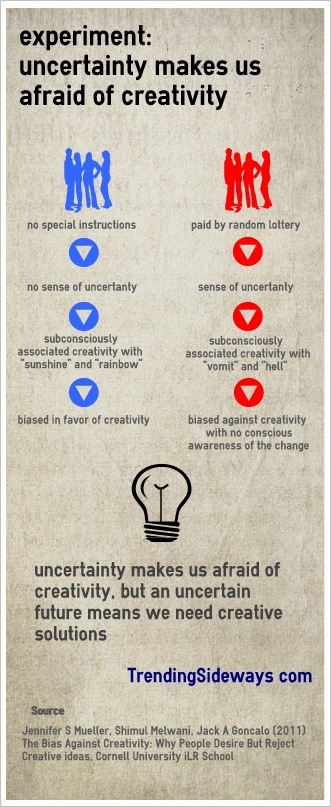 [dropdown_box expand_text="Information" show_more="More" show_less="Less" start="hide"]To begin with, the participants were split into two groups. The first group was told that some of them would get paid based on a random lottery, while the control group wasn’t. They did this to instill a sense of uncertainty, and pilot tests revealed that it worked.
They were then given two tests. One was a basic questionnaire to gauge how you felt about creativity. We’ve all seen questionnaires like this, where we rate our agreement with statements on a scale.
The other test went after our unconscious biases. They were asked to sit in front of a computer screen. One side of the screen was designated for creativity or practicality, the other side for good or bad.
Words started popping up on the screen. The participants were asked to push, for example, the left key for “creativity,” and the right key for “bad.” Reaction times were measured.
The idea behind the test is simple. If it takes longer for you to decide whether a word is “practical” or “bad,” it means that you subconsciously think practical things are bad.
As you might expect, the control group seemed to like creativity. They were more likely to associate words like “rainbow” and “sunshine” with “novel” and “original.”
Things didn’t turn out so well for the people who were put into an uncertain state of mind. Unlike the control group, they associated creativity with words like “agony,” “hell,” and “vomit.”
Worse still, the participants were completely blind to this bias. It didn’t show up on the questionnaire.
If you’re uncertain about the future, you become afraid of creativity. There’s just one problem with that. It’s when your future is uncertain that you need creative ideas the most.[/dropdown_box]
Tip #1: Cultivate feelings of certainty about the future whenever possible.
When Good Ideas Become Invisible
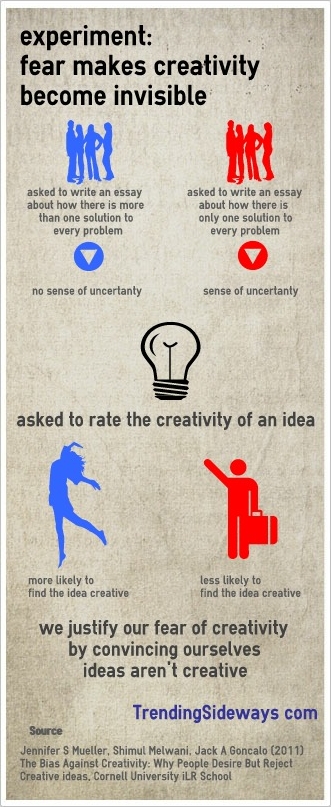 [dropdown_box expand_text="Information" show_more="More" show_less="Less" start="hide"]In the second experiment, the participants were again divided into two groups. One was asked to write an essay about how there is more than one solution to a problem. The second group was asked to write an essay about how there is only one solution.
Again, this was done to generate uncertainty. Tests showed that if you’re told to think that there’s only one right answer, it leads to feelings of uncertainty.
Afterward, the groups were given the same tests as in the first experiment, but then they were given a new task. They were asked to rate an idea based on its creativity, novelty, and practicality.
The idea they were asked to rate was pretty interesting: a shoe that used nanotechnology to adjust the thickness of its fabric in order to improve cooling and reduce blisters.
But those who had been asked to write an essay about how there’s only one right answer to any problem didn’t see it that way. They gave it lower ratings for creativity than everybody else.
This time, not only were the students blind to their bias against creativity, they rationalized it by thinking creative ideas were less creative.[/dropdown_box]
Tip #2: Embrace the mindset that there is more than one solution to every problem.
2. Embracing Creativity Through Paradox
If uncertainty makes us fear creativity, is there something we can do to embrace it?
Ella Miron-Spektor of Bar-Ilan in Israel (now at Technion-Israel institute of Technology), Francesca Gino of Harvard, and Linda Argote of Carnegie Mellon University in Pittsburgh conducted a study that suggests there is. Through subtle nudging, they helped participants embrace paradoxes. Apparently, this boosted creativity.
Here’s how they did it.
Accepting Contradictions
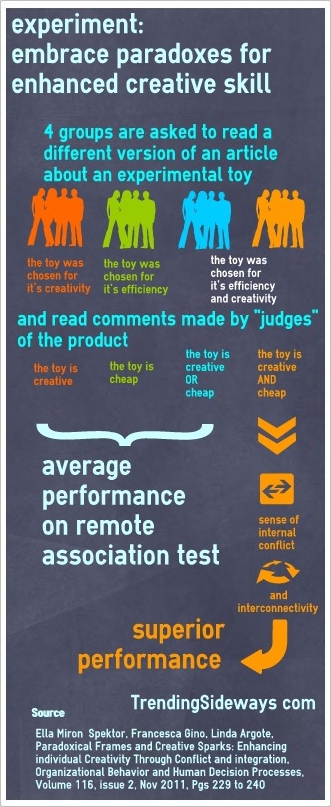 [dropdown_box expand_text="Information" show_more="More" show_less="Less" start="hide"]The participants, who were paid for the activity, were divided into four groups. Each of them read an article about a toy vehicle that could carry a cup of water without spilling it. The first group read a version of the article that said it had been chosen by a committee because of its creativity. The second was told it was chosen based on cost-effectiveness.
The last two groups were told that the toy had been chosen because it was creative and cost-effective.
Finally, each group read a series of comments made by “judges” of the product. The first group’s judges were amazed by the novelty of the product. The second group’s judges couldn’t believe how little it cost to make the toy. In the third group, each judge was either surprised by its creativity or by its efficiency, never by both.
In the final group, the judges were surprised that the toy was both creative and efficient, because efficiency and creativity are usually opposites.
The subtle suggestion of the judges had a surprisingly strong affect on the participants. A pilot study verified that the final group felt a sense of internal conflict and interconnectivity compared to the other three groups.
Each group was given a remote association test to see how their creative impulses had been affected. These types of tests look for a person’s ability to think “laterally” and notice connections between typically unconnected subjects.
For example, when given the words “shoulder,” “sore,” and “seat,” they were tested on their ability to guess that “cold” was the word common to all three of them. Remote association tests aren’t perfect, but their results almost always align with other types of creativity tests.
Which group did best? The one exposed to judges who were surprised by the fact that the toy was efficient and creative. The other three groups didn’t do as well, and performed at about the same level.
Just being exposed to some judges who thought the product was creative and some judges who thought it was efficient wasn’t enough.
Somehow, drawing attention to contradictions, and pointing out that they don’t have to be contradictions, was enough to boost creativity by about a third.[/dropdown_box]
Tip #3: Draw attention to the fact that things can be different and related at the same time.
Internal Conflict
[dropdown_box expand_text="Information" show_more="More" show_less="Less" start="hide"]Did paradoxes have some kind of mind expanding power, or was it the sense of internal conflict that made the participants more creative? And was the remote association task really enough? Was it really fair to say that somebody had become more creative just because it was easier for them to spot word associations?
Francesca, Ella, and Linda wanted to know more.
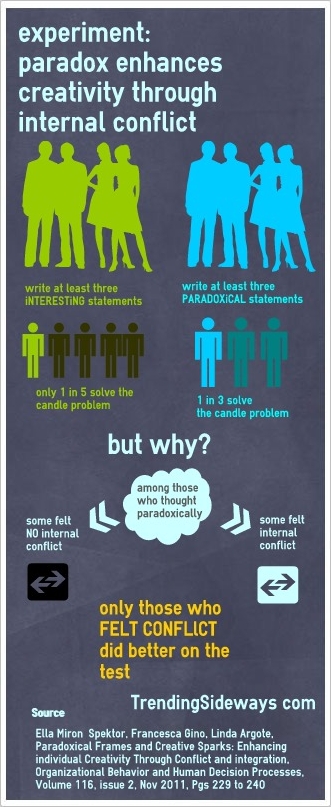
They ran another experiment. This time, the participants were asked to write. The control group was asked to write at least three statements they thought were interesting. The experimental group was asked to write at least three paradoxical statements that they found interesting.
The participants took three tests to measure the aftermath. First, they took a test to measure their sense of internal conflict. They were asked questions about feelings of discomfort, disorientation, and of course, conflict.
It’s probably not surprising that being asked to write paradoxical statements made people feel more internally conflicted. Based on the last experiment, it’s probably not all that surprising that they performed better on a remote association test, either.
To further test their creativity, they were given a classic test: the candle problem. This is when they give you a box of tacks, a pack of matches, and a candle. You’re asked to find a way to attach the candle to the wall in a way that allows it to burn properly without dripping on the floor or the table.
The solution is to use the tack box as a candle holder and tack it to the wall. Most people don’t think of the solution, since they are unable to get past the original purpose of the box, and they don’t think of it as being a part of the test.
About a third of the people who were asked to write paradoxical statements solved the problem. Only a fifth of the people in the control group could solve it. Clearly, thinking about paradoxes makes us more creative.
Or not.
When they analyzed the data, they stumbled across a surprising result. Only those who felt an internal sense of conflict became more creative. Even after tests verified that the participants had adopted a paradoxical frame of mind, it was only the ones who still felt tension between the opposing ideas that seemed to do better on the creative tasks.
Creativity isn’t about just accepting paradoxes. It’s about feeling the tension that comes with ideas being somehow true and contradictory at the same time.[/dropdown_box]
Tip #4: Encourage paradoxical thinking and draw attention to the sense of tension that it creates.
Understanding the Differences and the Connections
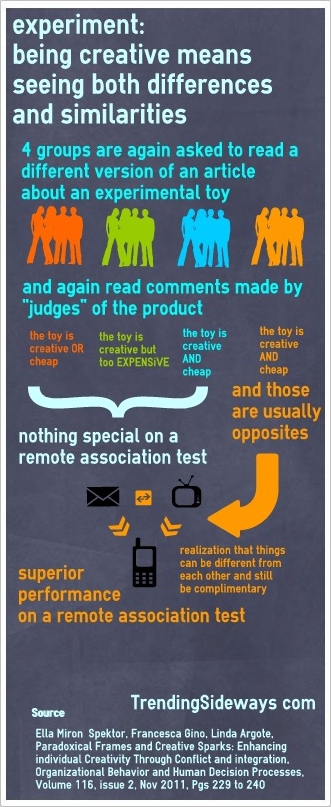 [dropdown_box expand_text="Information" show_more="More" show_less="Less" start="hide"]A third experiment hinted at the importance of a factor that went beyond conflict, called integrative complexity. It’s a measure of the ability to recognize and accept different perspectives, called differentiation, and the ability to link those perspectives together, called integration. It seemed to have an effect even in the absence of internal conflict.
The fourth and final study set out to explore this factor in its entirety.
This test took them full circle. They once again asked the participants to read the article about the toy, but this time the “judges” had different things to say.
The participants were split into four groups. The first group’s judges didn’t have anything very interesting to say. They told the participants that the toy was either creative or efficient, and that was it.
The second group read responses from high differentiation judges. They pointed out that creativity and efficiency are opposites, and said that the toy was creative but too expensive.
The third group was exposed to high integration judges. They didn’t draw any attention to the fact that creativity and efficiency are opposites, but they pointed out that the toy was both.
The final group read responses from high integration and high differentiation judges. These judges pointed out that creativity and efficiency were hard to pull off at the same time, but that this toy had managed to accomplish it.
Can you see where this is going?
It was the final group that displayed the highest creativity ratings on a remote association test. Simply understanding that two things are different, or understanding that two things are connected, isn’t enough. You have to understand that two things can be different and complimentary at the same time.
These results were very surprising to the experimenters. Previous research had shown that if you give somebody two contradictory goals, like creativity and efficiency, then creativity will suffer.
Somehow, while conflicting goals were bad for creativity, just understanding that things can be contradictory and still connected is actually good for creativity.[/dropdown_box]
Tip #5: Encourage looking for similarities as well as differences.
3. How are New Ideas Born?
 [dropdown_box expand_text="Information" show_more="More" show_less="Less" start="hide"]Why would this internal conflict, this tension between two opposing ideas that somehow fit one another, promote the production of new ideas?
Charles Darwin’s mentor, professor John Stevens Henslow, was a plant breeder. He trained Charles in the art of artificial selection. Darwin learned about variation in nature during this time, and how to select the plants with the desired traits.
Later, during a trip through the Galapagos Islands, Darwin was exposed to the various conditions on the islands, and they way that various species were similar, and different, from one another. It was during this trip that he thought of the idea of natural selection. The idea of artificial selection became combined with the conditions in nature that he was exposed to. The two ideas were different, but they could be combined with one another to form the basis of evolutionary theory.
A great deal of research suggests that new ideas are the result of a combination of other ideas. But exactly how this occurs in the brain is poorly understood. Still, as Dr. Robert Bilder has pointed out, perhaps the next step in our understanding of the universe it our growing ability to understand our own brains.
One popular hypothesis for the origin of new ideas is that brain cells, neurons, become synchronized with one another. Essentially, two ideas are blended together. Whenever two ideas are activated, the theory goes, maybe a single neuron lights up. But this model doesn’t explain why we can tell the difference between “Romeo loves Juliet” and “Juliet loves Romeo.” And there’s a bigger problem with this model.
It requires more neurons than exist in the human brain.
Other versions of the theory can manage with the right number of neurons if they restrict themselves to thinking about language specifically, but creative insight is a visceral experience that often uses all of the senses and isn’t confined by language.
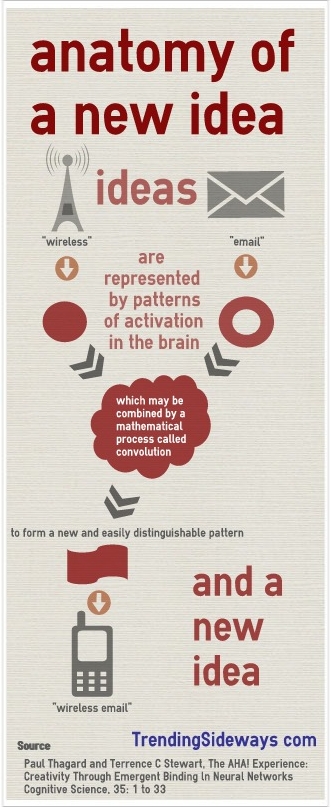
Paul Thagard and Terrence C. Stewart may have found a solution to this problem. They propose that the two ideas aren’t just added together, they become convoluted.
A convolution is a mathematical operation. If you imagine sliding the graph of one function over another one, a convolution is a graph of the way the intersection between those two graphs changes as they slide past each other.
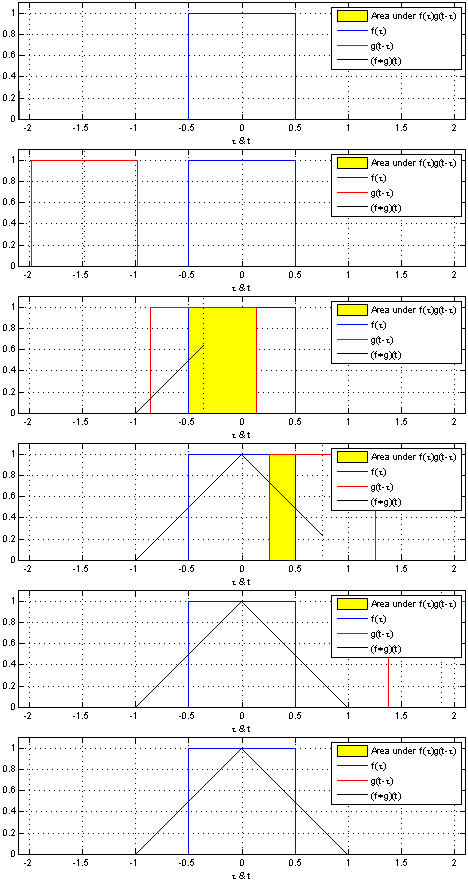
- Thank you Wikipedia
If that sounds and looks complicated, don’t worry, it is.
Paul and Terrance’s theory proposes that ideas aren’t simply added together, they go through a very complex process that takes on an entirely new form.
In the theory, ideas are represented by patterns of neural activity. To give you an idea of how this works, think of it like this. Suppose there is a brain cell that activates whenever you think about corn. Corn is associated with all kinds of other ideas in the brain: tastes, the color yellow, vegetables, plants, moistness, and so on. All these ideas are represented as a pattern of neural activity in the brain. The closer this activity is to a certain pattern, the faster the “corn” neuron fires.
Obviously, this is a simplification. There is no “corn” neuron, or “yellow” neuron. But this should make it a bit clearer how ideas are represented in the brain.
According to the theory, simply activating the patterns for “red” and “shirt” wouldn’t necessarily make you think of a “red shirt.” Instead, a convolution would have to occur that combined these two ideas into one.
The important thing about convolution is that it creates a new pattern that looks completely different from the first two patterns. The new pattern, “red shirt,” can’t be confused with the pattern for “red,” or the pattern for “shirt.”
Equally important, convolutions can be reversed, at least when a larger number of neurons are involved. The information that a “red shirt” is red, and that it’s a shirt, isn’t lost.
Obviously, we wouldn’t normally think of something like a red shirt as being a creative idea. But when other ideas are combined, ideas that seem contradictory at first but turn out not to be, we can get creative or even revolutionary ideas: social media, wireless email, sound wave, natural selection.
Whether or not Paul and Terrance are right, their theory gives neuroscientists an exciting new way to think about the birth of ideas. Rather than modeling it as a process of simple addition, they suggest ideas are combined together in much more interesting and complicated ways.
This could also offer some insight into the importance of internal conflict. If we adopt the view that two ideas are different yet somehow compliment one another, it becomes easier for two ideas to undergo a convolution.[/dropdown_box]
Tip #6: Allow ideas to mingle with one another.
4. Creativity and Mood
So creativity is boosted by internal conflict. Most people fear creativity when they feel uncertain. All of this means that creative people are tortured souls, right? After all, Van Gogh cut off his ear.
Maybe not.
The musician Sting once felt that he had to be tormented in order to be an artist. “I thought so, as most of my contemporaries did; you had to be the struggling artist, the tortured, painful, poetic wreck.” Eventually, he realized that he could be creative and positive at the same time. “And I’m thinking, well, I would just like to be happy.” Critics seem to agree. He won a Grammy in 2004 for Whenever I Say Your Name, long after he had decided to change is attitude.
A meta-analysis conducted by Charlotte Waddell found that, out of 29 studies analyzing a link between creativity and mental illness, only 9 of them found positive evidence, and most used flawed methods. Even in cases where a link is found, there’s rarely any attempt to find a cause and effect relationship.
There’s reason to suspect that, throughout history, “creative people” have been marginalized by society and tend to suffer from more economic problems. If there’s any correlation between creativity and mental illness, it could be because the creativity came first.
In recent years, various studies have investigated the impact of mood, called “affect,” on creativity.
Happy Entrepreneurs and Innovation
Robert Baron, of Oklahoma State University, and Jintong Tang, of Saint Louis University, were interested in the relationship between an entrepreneur’s mood and the firm’s creativity. Were the most creative entrepreneuers “tortured souls?”
While the results were self-reported, a survey of 99 randomly selected entrepreneurs suggested that this wasn’t the case at all. While the number of new products produced wasn’t correlated with mood, the level of innovation was.
The level of innovation was measured by questions such as whether the products made the previous incarnations obsolete, if they represented a fundamental shift, and whether previous expertise would no longer be applicable.
This was also compared against economic data for each firm’s sector of the market. Interestingly, they found that a more chaotic environment tended to increase creativity as well.
Of course, in this case, it’s certainly possible that the most positive entrepreneurs simply believed their products were more innovative.
A different study, conducted by Moon Joung Kim and Jin Nam Choi in South Korea, found similar results in the workplace. In this case, the creativity of employees was rated by their supervisors. The results suggest that people who are, in general, more positive also tend to be more creative in the work place.
The effects were strongest when the innovators were surrounded by people who were also generally positive, and when they were given more freedom to choose their peer groups. The effect of positivity on creativity was strongest for those who were capable of intuitive thinking, but not systematic thinking.
Tip #7: Encourage a positive mindset.
A Good Laugh Turns You Into an Innovator
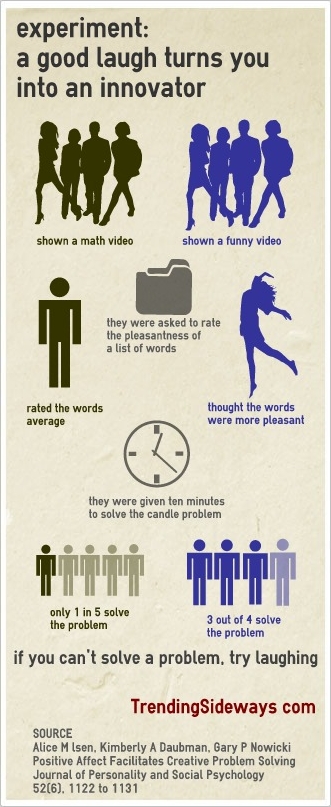
[dropdown_box expand_text="Information" show_more="More" show_less="Less" start="hide"]Skeptical of the tortured artist myth, Alice Isen, Kimberly Daubman, and Gary Nowicki designed a few experiments to test how positive mood influenced creativity.
In the first experiment, they had a control group watch a math video, and another group watch a gag reel. They advised the participants not to try to remember anything in the video, just to watch it.
Two other groups didn’t watch a video at all. Instead, they went straight into doing the candle problem discussed above. One of the groups was given the traditional candle task. The other group was given a simplified task, where the tacks had already been removed from the tack box. Previous experiments have shown that the problem is easier to solve when the tacks are already separated from the tack box.
To measure how the gag reel and math film affected the participants, they were asked to rate the pleasantness of uncommon words. Not surprisingly, the people who watched the gag reel rated the words higher on the pleasantness scale.
All the participants were given ten minutes to solve the puzzle.
The participants who either watched the math video or went straight into the traditional candle test performed at about the same level, although the ones who had seen the math video did slightly better (20 percent versus 13 percent).
The group that performed best was the one that was given the box separate from the tacks. This allowed them to think about the box as a part of the experiment and to think about alternative uses for it. A staggering 83 percent of them completed the task. This group didn’t solve the problem because they were more creative. They solved it because it had been spelled out for them.
Those who had watched the gag reel did almost as well. A full 75 percent of them were able to solve the problem. Evidently, there was something about being in a positive mood that allowed them to think of alternative uses for the box.
Again, that’s one fifth of the math viewers versus versus three fourths of the gag reel viewers. This is not a small effect.
When I talked to Marvin Bartel about this, he pointed out something I thought was interesting: the similarity between paradox and humor.
Jokes are frequently based on the surprising punchline that reveals an unexpected similarity made obvious. This is a form of boundary breaking.
I believe there is a great deal of truth here, but is humor the only positive emotion that helps with creativity?[/dropdown_box]
Tip #8: Encourage laughter.
Happiness or Humor?
Alice Isen and the others wanted to test whether it was general happiness or just a good laugh that boosted creative problem solving skills. First, they tried modifying the experiment by introducing a group that received a candy bar as a gift. They also included a group that watched a negative film, and one that simply exercised, since it was possible that arousal was the real source, not laughter.
While this test succeeded in demonstrating that arousal alone didn’t have any effect, nor did the negative film, the candy bar ended up backfiring. The experimenters suspected that either a candy bar wasn’t enough, or that asking them a question about their mood made them immediately suspicious of why they got the candy bar in the first place.
Not content with that, they designed another experiment. This time around, they thanked the participants for coming and gave them a decorated bag of candy. This seemed to have the desired effect when the participants took a remote association test.
A Note on Anger and Sarcasm
The link between mood and creativity goes beyond happiness, of course. Ella Miron-Spektor, who lead the study exploring the link between creativity and paradox discussed earlier, also explored how anger influenced creativity. She and her colleagues found that being exposed to an angry customer actually increased their performance on analytical problems, but decreased their performance on creative problems.
In a bizarre turn of events, however, she found that sarcasm actually increased the ability to solve creative problems. This is likely the result of the dual meaning hidden in sarcasm, and is probably connected to the notion of paradox discussed above.
Tip #9: Minimize anger if possible. Bizarrely, sarcasm can actually be helpful.
5. Does Money Suck the Life Out of Creativity?
If mood is connected to creativity, can we use money to boost mood, and therefore creativity? As it turns out, the answer is more complicated than you might expect.
When the Chilean miners were trapped down the mine shaft in 2010, a team of psychologists was charged with maintaining their mental health. In an effort to get the miners to cooperate, the psychologists would incentivise them with TV, music, and pictures of the outside world. Some people were outraged by this, and it draws attention to the fact that the carrot and stick approach can be controversial.
But what does science have to say about incentives and their relationship with creativity?
Dan Pink gave an excellent TED talk on the subject a few years back. Once again, we have the familiar candle problem. This time around, experimenters sponsored by the Federal Reserve discovered that offering participants a financial reward for solving the problem made them less likely to solve it.
But is that the whole story? Actually, no.
Psychological research is divided into two camps, with two very different worldviews. To sum things up: you have your behaviorists, who believe that all behavior is basically Pavlovian. Rewards and punishments determine everything.
On the other end of the spectrum, you have the cognitivists, who strongly believe in the power of intrinsic motivation, that things can be internally motivated.
Pure behaviorism, once championed by B.F. Skinner, has been largely discredited. The notion that all behavior can be explained by external stimulus has been challenged by a great deal of experiments. Obviously, the experiment discussed in the video above is a great example.
At the same time, we must be careful not to draw conclusions too easily. While intrinsic motivation is very real, powered by a strong dopamine system in the brain referred to as the SEEKING system, it’s not everything.
Studies that attempt to step outside of the cognitivist and behaviorist camps have discovered that it is possible to incentivise creativity, but only when it is approached in the right way.
The Right Way to “Bribe” Creativity?
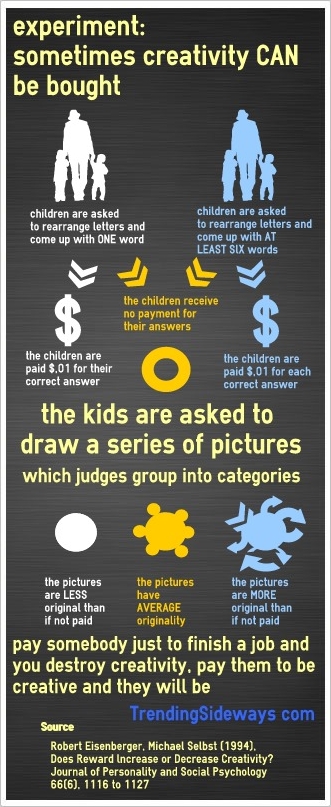
[dropdown_box expand_text="Information" show_more="More" show_less="Less" start="hide"]Behaviorist experiments seem to suggest that you can buy creativity, while cognitivist experiments suggest that this is counterproductive. Robert Eisenberger of the University of Delaware, and Michael Selbst from Temple University, wanted to explore these contradictions.
To test exactly what was going on, they set up an experiment for fifth and sixth graders. To start, they gave the children a word creation task. They were shown a word, like “brontosaurus,” and asked to make new words using as many of the letters as they wanted.
They primed one group of kids for low creativity by asking them to come up with only one word. The other group of kids was asked to come up with six words.
Each of these two groups went through one of three different reward conditions. In the first condition, they were given no rewards. In the second, they were given a penny for each answer. In the third, they were given ten pennies for each answer.
Afterward, the children were asked to draw a series of pictures that incorporated an already existing circle. The children’s drawings were then categorized and compared with one another, so that the least common responses would be deemed the most creative.
As you might expect from the video above, the kids who received a penny after being asked to come up with a single word ended up drawing far less original pictures. But the kids who got a penny for coming up with a series of words ended up drawing more original pictures.
The experimenters tested the data to make sure that this wasn’t the result of a simple difference in the quantity of pictures, and found that it wasn’t.
Incentives alone don’t hurt creativity. The trouble starts when you reward people for thinking linearly, instead of creatively. Put simply, if you want people to be more creative, you reward them for creative solutions, not just good solutions.
Only there’s more to it. The children who had been paid 10 pennies for each answer behaved the same as if they hadn’t been paid at all.
Why would a larger reward eliminate all the benefits? Robert and Michael had a guess, and they put it to the test. In a similar experiment, they rewarded all children ten cents for each answer. The difference was, one group was shown the money right away. The other group was told about the reward, but it was placed in a cup, out of view.
Robert and Michael’s suspicions were initially confirmed. If the reward was too large, it became a distraction. The kids weren’t thinking about the task anymore, apparently, they were thinking about money.
However, when I contacted Robert about this study, he pointed out that quite a bit of progress has been made since. A meta-analysis that he was involved in found that, as long as people are explicitly rewarded for creativity, they will usually produce more creative work. (1) It’s when people are only rewarded for merely completing a task that incentives can actually be harmful.
Robert was also careful to point out to me that, “intrinsic interest plays an enormous role in creativity but rewards should not be overlooked.”
A later experiment he conducted revealed that the group of incentivized children would always perform better, regardless of the size of the reward. In the experiment above, Robert realized that the children may not have been aware that they were being rewarded for creativity.[/dropdown_box]
Tip #10: When incentivizing creativity, make sure it is explicit that the incentive is for creativity, not simply for finishing a job, or you can actually hurt creativity.
Can it Really Be Bought?
 [dropdown_box expand_text="Information" show_more="More" show_less="Less" start="hide"]The frustrating truth of psychological research is that it often seems to contradict itself. The last experiment would suggest that as long as you incentivise for creativity, and the incentive isn’t too large, you can encourage creative output.
But Steven Kachelmeier, Bernhard Reichert, and Michael Williamson ran a similar experiment, and got different results. This draws attention to an important fact about creativity research. There is no universal scientific definition of creativity. Every study discussed in this article is measuring something slightly different, but related.
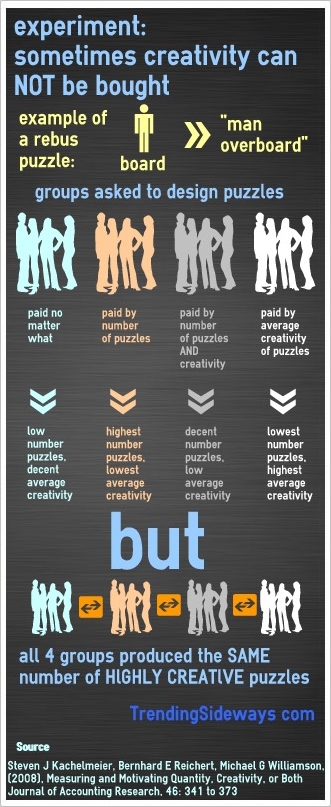
What were Steven and Bernhard measuring? They wanted to see how incentives would affect their participants’ ability to produce rebus puzzles, which are similar to Pictionary puzzles. The participants were shown examples, such as the word “man” over the word “board,” representing the phrase “man overboard.”
The participants were split into four groups. The control group received instructions that they would be paid $25 no matter what they did. The three others were rewarded based on the number of puzzles they produced, the creativity of their puzzles, or a weighted combination of both.
Creativity was rated by eleven judges. The subjective results given by the judges were corroborated in a more objective way by comparing the puzzles with the examples the participants had been shown. The puzzles rated most creative had the least in common with the example puzzles.
Based on the outcome in the above experiment, with the school children, the results aren’t too surprising at first glance. Those who were rewarded for quantity produced more puzzles than the control group, and had a lower average creativity score than the others. Those who were rewarded for creativity produced fewer puzzles than the control group, and had a higher average creativity rating.
Things got more interesting when the participants were rewarded for creativity and quantity. Oddly enough, the group that produced the highest weighted productivity score was actually the group that was rewarded for producing quantity.
Why?
As they dug deeper into the data, they discovered that the creativity incentives weren’t actually boosting overall creative output. Instead, the participants who were compensated for average creativity were simply following through on only their best ideas.
All four groups appeared to produce the same number of very high quality ideas. Any differences between them didn’t achieve statistical significance. Similarly, comparing the absolute best idea from each person, incentives didn’t seem to have any effect.
The results of this study have some interesting implications for employers. If you were only concerned about the number of exceptionally creative ideas, incentives don’t seem to make a difference. If you were interested in getting the highest number of exceptional ideas, as well as the highest number of ideas overall, it would make sense to reward based on quantity alone.
Then again, in a world where information overload is a genuine problem, compensating based on creativity might not be a bad idea, even if all it achieves is a reduction in noise.[/dropdown_box]
Tip #11: Recognize that, for certain types of problems, incentives will not increase the number of creative ideas, it will only filter out the less creative ones.
6. The Solo Artist and the Corporate Committee
If buying creativity doesn’t always work, can you encourage it in the way that groups are structured? Everything we’ve talked about so far suggests that if you can encourage a positive mood, embrace paradoxes and the tension that comes with them, avoid feelings of uncertainty, encourage lateral thinking, and combine dissonant ideas, you can boost creativity.
But what if creativity needs something even more unexpected? What if it needs conformity?
Why Creativity Needs the Mainstream
 [dropdown_box expand_text="Information" show_more="More" show_less="Less" start="hide"]The answer to this question once again comes with the help of Ella Miron-Spektor. With the help of Miriam Erez and Eitan Naveh, she explored the dynamics of group creativity. The results were summarized in the Harvard Business Review.
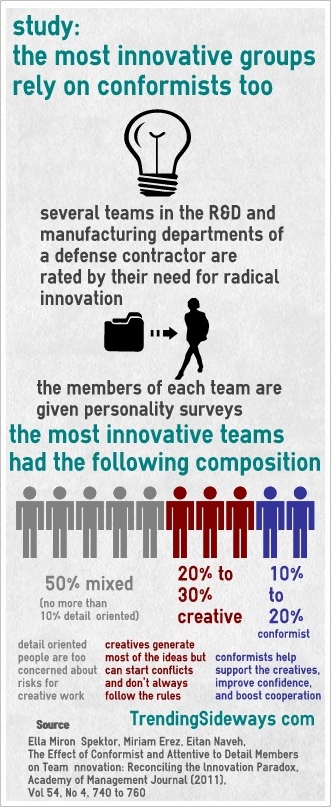
The study focused on research and development teams that worked for a company in the defense industry. This was chosen because innovation is an important part of the job, and because quality control standards are very high.
The researchers gave the team members personality surveys to measure three traits: creativity, conformity with rules and group mentality, and attention to detail. Those who scored in the top 20 percent for each category were “labeled,” for the purposes of the experiment, as falling under that category. For example, if eighty percent of the people who took the survey scored lower than you on conformity, you were considered to be a conformist.
The team managers were asked to rate the purpose of their team by dividing 100 points among these four groups:
- Duplicating technologies
- Modifying technologies
- Adapting technologies for completely new purposes
- Creating completely new technologies
The number of points allocated to these groups was used to evaluate the amount of radical innovation expected of the team.
The potency (essentially morale), task conflict, and adherence to standards among each team was also measured using a survey. The agreement among team members on these answers was robust.
To avoid confounding the data, they also controlled for team size and function (some of the teams worked in R&D, others in manufacturing).
The results were surprising. The most radically innovative teams didn’t have the highest proportion of creative people. Instead, they seemed to consist of about 22 percent creatives, 16 percent conformists, and 11 percent detail oriented people.
Why was this the case? For whatever reason, creative people are more likely to instigate conflict. Less surprisingly, they are also less likely to be concerned about adherence to standards.
And yet these apparent detriments didn’t have any effect on radical innovation.
Only one process seemed to play a part: potency. The presence of conformists helped foster a sense of confidence that the team would be able to meet its goals. Without them, teams seemed to lose morale.
Oddly enough, the presence of detail-oriented individuals also seemed to boost potency, but somehow didn’t offer any benefits. Teams with no detail-oriented members appeared to do just as well. In fact, too many of them was somehow harmful to creativity, because they cannot tolerate ambiguity and prevent the team from exploring risky and unusual solutions.[/dropdown_box]
Tip #12: Creative teams need a few conformists to improve morale and certainty. Detail-oriented people, however, tend to bog down the process.
Teams Versus Individuals
 [dropdown_box expand_text="Information" show_more="More" show_less="Less" start="hide"]So creative teams need a few conformists in order to stay confident in their abilities. But what if we don’t need teams at all?
If creativity is all about combining ideas, it seems obvious that groups should beat individuals. And yet this hypothesis has been tested again, and again, and again.
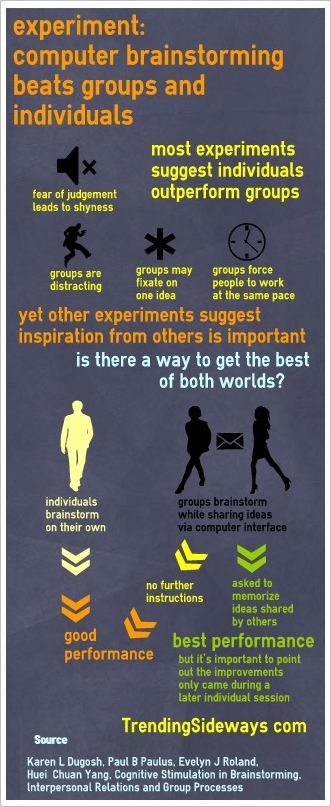
Experimenters have tried adjusting an extraordinary number of variables. But when you compare a team of people in the same room with the same number of people working alone, the individuals almost always win. They come up with more ideas, and they come up with more creative ideas. Most experiments suggest that, at best, a brainstorming team can only break even.
Research offers a few reasons. People are more shy in groups. They are afraid that their ideas will be judged. At the same time, their thought processes are interrupted by the others in the group, and they forget where they were going with their ideas. The group begins to focus in on the most popular ideas, causing lateral thinking to diminish. Individuals work at their own pace, but people in a group adjust their pace to match the group, which leads to fewer ideas being generated. Almost all efforts to counter these effects only result in a team that does as well as a group of isolated individuals.
Despite all of this, the benefits of exposure to alternative perspectives are real. Karen Dugosh, Paul B. Paulus, and their colleagues demonstrated this using three experiments at the University of Texas.
In the first experiment, the participants listened to a tape of a person presenting ideas about a topic, and were asked to brainstorm on that topic. They came up with more original ideas than those who didn’t listen to a tape. Some of the participants were also asked to memorize what was being discussed on the tape. This improved their performance even more, although only in a later session when they weren’t listening to a tape.
The second experiment was similar, except that the tapes were altered. This time around, the tapes contained either a low or high number of ideas, and included either a low or high amount of “filler” that wasn’t directly related to the topic at hand. Those who received the high filler, low idea tape did worse than a control group, but everybody else did better than if they didn’t listen to a tape. The groups who received a tape with a high number of ideas, regardless of filler, did best of all.
Perhaps most importantly, both of these experiments point out that the best ideas came after the participants listened to the tape. In other words, an individual brainstorming session after a group brainstorming session might be a better choice than simply one or the other.
The final experiment is especially interesting. In this case, a group brainstormed ideas and shared them with each other through a computer interface. This has all the benefits of sharing ideas, without many of the detriments, like interruptions and “visceral” judgement.
When the participants weren’t asked to pay attention to responses from others, they didn’t do any better than individuals working in isolation. But when they were asked to memorize the ideas of the others, they outperformed all the other groups. Again, this only happened in an individual brainstorming session that took place after the group session.[/dropdown_box]
Tip #13: The best ideas usually happen during individual brainstorming sessions, but are improved upon by interactions with other people beforehand, or by written interactions that don’t distract from the process.
Criticism is Good?
 [dropdown_box expand_text="Information" show_more="More" show_less="Less" start="hide"]Does all this mean that, if we want to maximize creativity, we’re doomed to lives of solitude, at best exchanging a few ideas on a computer screen? As it happens, no. There is a way for group brainstorming sessions to compete with isolated sessions, but it goes against everything you’ve ever been told.
Criticize.
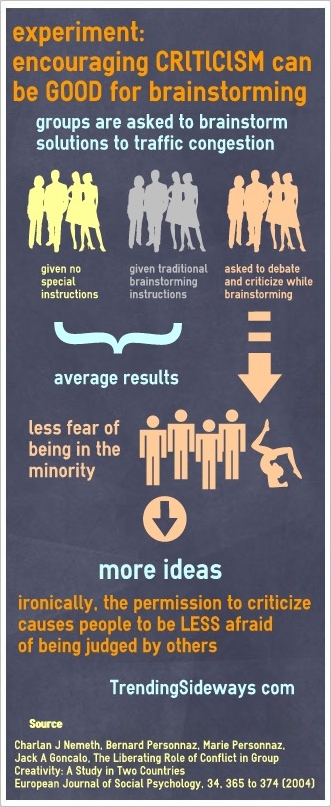
Charlan Nemeth and her colleagues tested the effects of criticism on group brainstorming sessions. To make things as robust as possible, they ran the same experiment in both the US and France.
The participants were asked to come up with as many good solutions to traffic congestion as possible in twenty minutes. A control group wasn’t given any further instructions.
The “standard” group was given the traditional brainstorming instructions, including the advice not to criticize each other. The experimental group was given the same instructions, except that they were encouraged to engage in debate and criticism.
The results would be shocking to anybody that buys into traditional advice. For one, the groups that were given the traditional instructions didn’t do any better than the group that wasn’t given any instructions. But the real shocker here is that groups which were encouraged to debate did better than the others.
Traditional wisdom and common sense suggest that criticism should make people fearful. If people are allowed to criticize you, shouldn’t you be afraid of judgement? Shouldn’t that make you less likely to share your original ideas?
The answer lies in a phenomenon known as groupthink. A classic study by Solomon Asch demonstrated that people will side with the majority, even if they are wrong. When asked to compare the length of lines, even if the answer is relatively obvious, they will tend to assume that they are missing something.
Previously, Nemeth explored how dissent affected groupthink and creativity. Groups were shown a series of blue slides and asked what color they were. When they were exposed to a majority who said the slides were green, they were more likely to call the slides green.
More interestingly, if they were exposed to a minority who called the slides green, while this didn’t have an effect on what color they thought the slides were, it did cause them to do better on a subsequent creativity task.
The assumption has always been that criticism makes people fearful that they will be criticized. The reality is that people aren’t afraid of being criticized, they are afraid of being wrong, of disagreeing. By fostering an environment where debate and criticism are encouraged, we paradoxically feel more comfortable sharing ideas that others might not agree with.[/dropdown_box]
Tip #14: Encouraging criticism and debate during brainstorming allows potentially less popular ideas to be heard.
The Importance of Facilitators
 [dropdown_box expand_text="Information" show_more="More" show_less="Less" start="hide"]When I first contacted Dr. Robert Alan Black for input on this article, he recoiled at the introduction, which he thought was too sensationalist. He has been frustrated with the way that the popular press attacks brainstorming, probably with only one real goal: to write headlines people will click on.
Obviously, I wasn’t happy with the assumptions he made about where the article was headed, but his intuitions were strikingly prescient about one thing. I was going to claim that individuals almost always beat groups, as that is what most of the research I came across asserted.
I’m glad I contacted Robert.
He put me in touch with Dr. John F. Cabra, who sent me a paper by Scott Isaksen and John Gaulin, of the Creative Problem Solving Group.
While the studies above are meaningful in their own right, what some of the researchers and most of the press have failed to realize is the role that facilitators play in the brainstorming process.
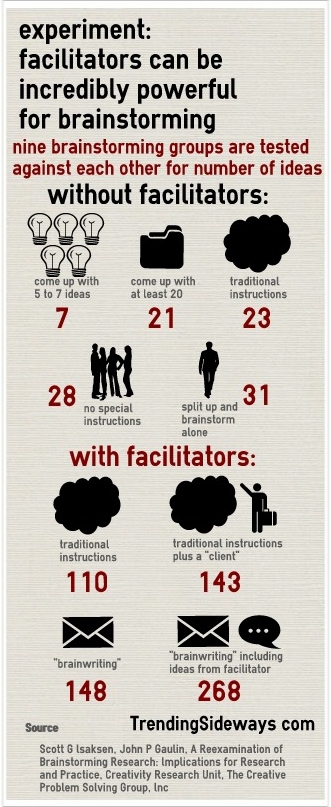
The study analyzed the effectiveness of nine different groups, each using a different approach for brainstorming. Some of the groups had a facilitator who was highly trained in the art of brainstorming.
1. Have an open discussion with no further directions.
2. Come up with 5 to 7 ideas.
3. Come up with at least 20 ideas.
4. Use a technique known as brainwriting, where people think of ideas and write them on cards, sharing them with each other and reading them at their own pace. This offers many of the same benefits as brainstorming through a computer mediated interface, since people can share ideas without interrupting each other. This group had a facilitator help them generate ideas.
5. This group also used brainwriting, this time with a facilitator who explained how to do it, but who did not participate.
6. These were individuals who brainstormed alone. They were given the traditional instructions for brainstorming, but they did not have a facilitator.
7. These were groups of people who brainstormed together. They were also given the traditional instructions for brainstorming, but they did not have a facilitator.
8. This group used traditional brainstorming with a facilitator.
9. This group used traditional brainstorming with a facilitator and somebody acting as a “client.”
Needless to say, this study put a wide variety of approaches to the test. As the previous studies would have us expecting, the individuals beat the brainstorming groups who didn’t have a facilitator. Interestingly, the groups that were told to generate a specific number of ideas only generated that many ideas, going no further.
However, the groups that worked with a facilitator in any capacity blew the other groups out of the water. The worst of them generated three times as many ideas as the group of individuals (110 versus 31). This was the group who used traditional brainstorming with a facilitator.
The group with a facilitator and somebody who acted as a “client” did better, with 143 ideas. The brainwriting group who got instructions from a facilitator did slightly better, with 148 ideas. Finally, the brainwriting group with a facilitator who helped generate ideas produced a whopping 268 ideas.
While I would have liked to see a comparison with a group of individuals who received training from a facilitator, and the sample size wasn’t extensive, the results are clear. Even with a small sample size, it’s hard to argue against an effect this large. Groups certainly can outperform individuals under some circumstances, and facilitators can be incredibly important.
Unfortunately, not all facilitators are created equal. A similar experiment conducted by Paul B. Paulus and his colleagues used facilitators with several years of experience, but they didn’t appear to have any influence over and above simply giving the participants a sheet of instructions. Furthermore, the facilitated groups failed to outperform individuals working alone except on one measure, the facilitated groups expressed th